Perspective
After the ribbon-cutting: What Levi’s opening reveals about Chicago’s creative power

Hebru Brantley’s FLYBOY artwork at the Levi’s Chicago flagship, November 6, 2026. Photo: Antonio Perez / Chicago Tribune.
|
4 min

The first thing I noticed was the scale of the space: multiple floors, high ceilings and a tailor shop in the back. There was food and there were drinks, but it was the possibility of the space that stood out to me. It felt built for production as much as retail, a place that could bring people together and give them something to experience beyond a screen.
Levi’s opened its new Chicago flagship at Michigan Avenue and Erie to the public on November 6. At the opening event I attended on November 5, everyone seemed to have their own take on denim: light wash, dark wash, all black, Canadian tuxedos. There were familiar faces throughout the room, and the whole thing felt like a reunion of friends and peers having a good time. Levi Strauss & Co.
Chance the Rapper performed, and the crowd sang along. The energy was electric and unmistakably Chicago. I also noticed nonalcoholic drinks, a small detail that made me think about how a good gathering can make room for people who want to enjoy the night without drinking.
The Tailor Shop stood out to me for another reason. It gives people a way to make something their own through alterations and customization, from patches to embroidery. That kind of personalization adds a layer to shopping in person: you can interact with the product and leave with something that feels more like you. Levi’s did a good job of making that experience part of the space. Chicago Tribune

Embroidery being prepared at the Levi’s flagship Tailor Shop on November 6, 2026. Photo: Antonio Perez / Chicago Tribune.
Chicago creatives in the mix
What impressed me most was the decision to spotlight people who have been putting in the work here and have deep roots in the community. A brand entering a market or refreshing its image can get that relationship wrong when the connection feels inauthentic. To me, this opening showed what it can look like when local creatives are part of the story.
Ron Louis and the details
Chicago designer Ron Louis created an opening-weekend capsule for the flagship. Levi’s also announced live customization and a garment-repair workshop with Louis and Chicago Youth Programs. His Blue Tag work makes this collaboration feel like a natural fit: Levi’s is a quintessential denim brand, and Ron has a way of remixing familiar materials and details so they become unmistakably his own.

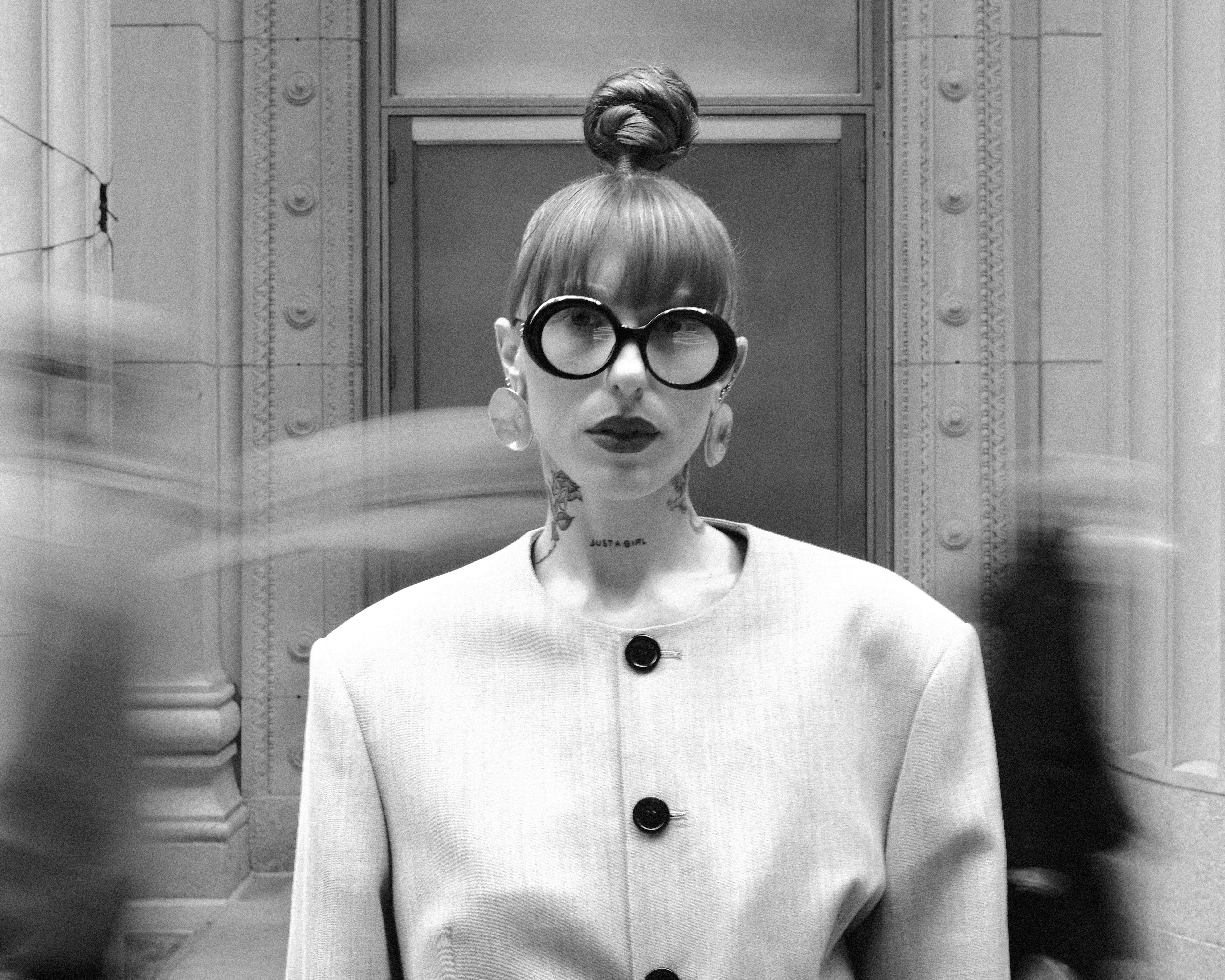
Levi’s Chicago campaign detail. Photo: Lyndon French for Levi’s.

Levi’s Chicago campaign detail. Photo: Lyndon French for Levi’s.
I keep coming back to the glacier blue in his work, the distressing and the way he reimagines existing pieces. What interests me is the balance between heritage and newness: working within a brand’s codes while giving a creative enough room to bring their own identity to the collaboration. That is when a partnership has the potential to benefit both sides.
Manny’s vintage vision
Emanuel “Manny” Edwards of The Goody Vault brings a different perspective. Levi’s says he curated 90 vintage Levi’s pieces for the flagship, spanning the 1950s through the 1990s. That collection is separate from Ron’s capsule, and it draws attention to the life a garment can have long after its first owner.
Manny is a superstar, and his eye for vintage reminds me that good clothes can outlive us. In a 2023 InsideHook profile, he described teaching himself to mend and developing a distinctive approach to visible repair. There is beauty in bringing something old forward without erasing the history it carries.

Emanuel “Manny” Edwards of The Goody Vault. Image: Goody Vault / via InsideHook.
What the room made me think about
The opening also brought me back to our work on Racket with Wilson. We brought in seven local wardrobe stylists to show how a heritage brand’s clothes could be interpreted through local creative perspectives. Wilson was founded in Chicago, and that connection made the work feel especially close to home. Seeing the Levi’s opening made me think again about how much a local point of view can add when it is given space to lead.
Chicago’s retail momentum
The jolt of energy I’m feeling comes from more than one opening. Levi’s on Michigan Avenue, A Ma Maniére and Live Launch in the West Loop are part of a wider set of new spaces I’ve been noticing across Chicago. Axios describes Live Launch as a modern mall bringing online-based brands into a physical space, adding another idea to the conversation about what shopping can be. After years of negative attention on vacancies, seeing these places open and people gather in them feels like the city is turning a new leaf. These are different spaces in different neighborhoods, but together they have me thinking about what retail can make possible.
There is reporting behind that sense of movement, too. The Chicago Sun-Times reported a flurry of openings on the Magnificent Mile and, citing a local brokerage, a lower vacancy rate than in 2025. That is specific to the Mag Mile, not a measure of every Chicago neighborhood or proof that all the challenges have been resolved. What interests me is how these new spaces can become places for people to participate, not only places to buy something.
What lasts after the opening
As someone working to build Chicago’s fashion ecosystem, I think about vibrancy as more than the energy in a room. It comes from the people, places and relationships that make a city worth being part of, and from the opportunities that allow them to keep creating. Community is infrastructure: the connections between local creatives, retailers, corporations and public and private partners can help turn a moment into something that lasts.
An opening can introduce those relationships, but what happens afterward matters too. Are creatives given room to shape the work, compensated for their contributions and able to access opportunities beyond the first event?
My challenge to major brands and retailers is to keep that momentum going. Build relationships that last, invest in local talent consistently and make space for Chicago creatives to help shape what comes next. The people and ideas are already here; sustained collaboration can help more of that work reach the city and beyond.
I think about the relationship between looking back and moving forward. The past gives us material to learn from and reimagine, whether that is a vintage garment, a heritage brand or the creative knowledge already present in our neighborhoods. From the block to the city and beyond, Chicago fashion has a story worth carrying forward.
COntinue reading
Latest stories